Perovskite Quantum Dots for Quantum Technologies
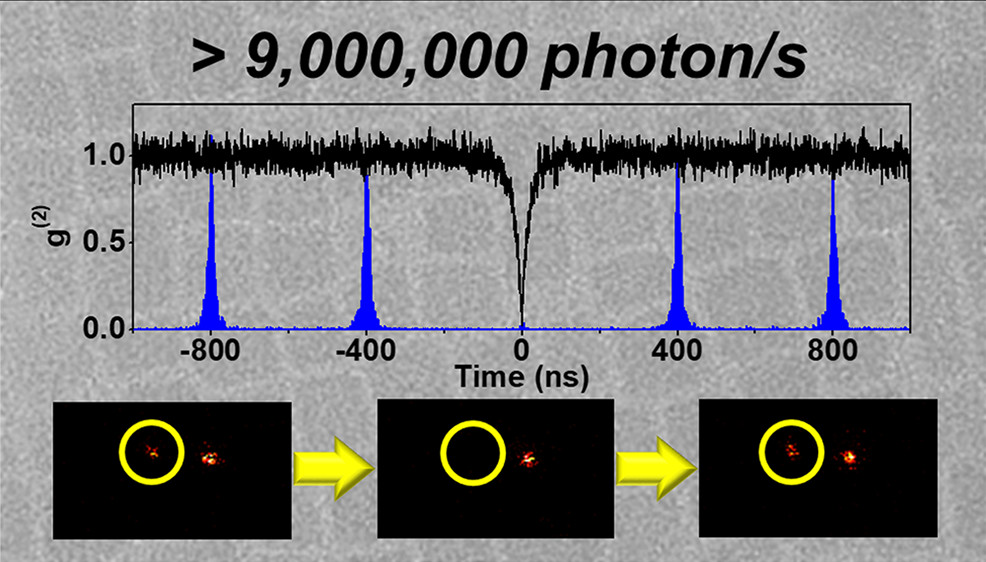
Photon antibunching from a single perovskite quantum dot.
Quantum light sources emit photons one at a time, with well-defined timing and polarization. They are the basic hardware of quantum key distribution and photonic quantum computing. Colloidal halide perovskite quantum dots combine solution synthesis, near-unity quantum yield and fast radiative recombination with strong photon antibunching. They perform across a wide temperature range, from cryogenic conditions — where narrow linewidths and long coherence times matter most — up to room temperature, where practical devices operate.
We synthesize highly stable perovskite quantum dots and study them one dot at a time, from room temperature down to cryogenic temperatures, using photon-correlation and time-resolved spectroscopy to characterize single-photon purity, blinking, exciton fine structure and spin dynamics. Cooling narrows the emission linewidth and slows dephasing, resolving the bright- and dark-exciton fine structure that thermal broadening hides at room temperature. Coupling individual CsPbI3 dots to plasmonic nanocavities shortened the radiative lifetime below 12 ps and produced a single-photon emission rate above 2.3 × 10⁹ counts per second.
Current research directions:
Solvent-resistant, non-blinking perovskite quantum dots. Single-dot photon-correlation spectroscopy at room and cryogenic temperatures. Plasmonic and photonic nanocavity coupling. Exciton fine structure, coherence and spin dynamics. Entangled-photon generation from the biexciton cascade.